

Let our team help you navigate the ever-changing benefits compliance landscape each month. Check out this month’s latest alerts, additional updates, and resources hot off the press:
Employee Benefits Compliance Alerts
This month’s Compliance Matters newsletter provides a comprehensive review of the following topics. To obtain your copy, please use the form below to download.
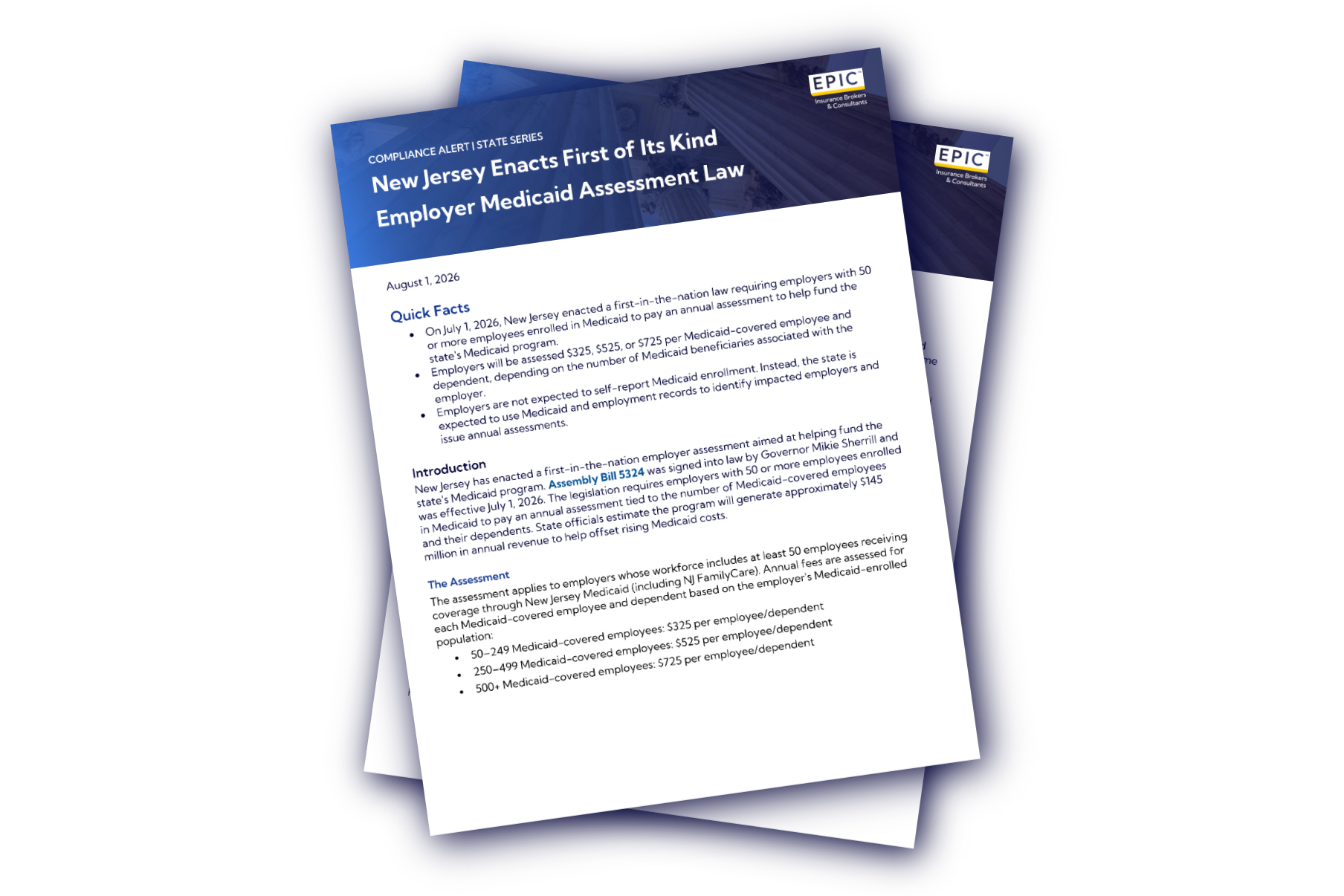
- IDR: CMS Releases 2025 Data and Updated Timeline for New Regulations
- Employers Gain Flexibility Under New Paid Leave Tax Credit Guidance
- DCAP Nondiscrimination Testing Update
- Handling Medical Loss Ratio (MLR) Rebates
- State Series: Minnesota Life Insurance Continuation
- Litigation Series: Court Allows Challenge to Cigna’s Automated Claims Review Process to Proceed
Download this month’s alerts
"*" indicates required fields
Additional Updates & Resources
Reminder! Summary Annual Reports for Calendar Year Plans Due Soon
Group health plans with at least 100 plan participants at the beginning of a plan year are required to furnish a Summary Annual Report (SAR) to each health plan participant. The SAR is a summary of the information reported in the Form 5500, which is due annually at the end of the seventh month after the end of a plan year, which is July 31 for calendar year plans. The SAR must be furnished within nine months following the end of the plan year. Plans with a calendar plan year that filed Form 5500 for the 2025 plan year by July 31, 2026, must furnish the SAR by September 30, 2026. Plans that filed a Form 5500 extension will have additional time to provide the SAR. For calendar year plans that filed a Form 5500 extension in 2026 for the 2025 plan year, the SAR deadline will be December 15, 2026.
Medicare Part D Disclosures Due in October
Group health plans that offer prescription drug coverage are required to notify Medicare-eligible plan participants about the plan’s drug coverage status. The creditable coverage notice is due each year before October 15, which coincides with the first day of Medicare’s annual enrollment period. Individuals without creditable prescription drug coverage who delay enrolling in Medicare Part D may incur a lifetime late enrollment penalty.
Notices may be included with other enrollment materials if prominently displayed, delivered electronically under applicable Department of Labor (DOL) rules, or mailed using regular United States Postal Service delivery. If mailing the notice, remember to get the notice in the mail in a reasonable time to ensure timely receipt as Medicare Part D notices must be postmarked by October 14 to be compliant with the distribution requirements.
Notices must be provided to all Medicare Part D-eligible individuals covered by or applying for the plan, including eligible employees, retirees, Consolidated Omnibus Budget Reconciliation Act (COBRA) coverage participants, spouses, and dependents. CMS model notices are available and recommended, although employers may use customized notices if all required information is included.
For more information access our prior Alert from September 2025.
EBSA Provides Updated Guidance for Wellness Programs
On August 26, 2026, the Employee Benefits Security Administration (EBSA) on behalf of the Departments of Labor (DOL), Health and Human Services (HHS), and Treasury (collectively, “the Departments”) issued new guidance addressing ongoing litigation involving tobacco surcharges in employer-sponsored health plan wellness programs. The guidance confirms that, pending further regulations, federal agencies will not take enforcement action against plans that provide wellness incentives prospectively, rather than retroactively to the beginning of the plan year, when participants satisfy a reasonable alternative standard (RAS) to earn a reward. This position provides welcome flexibility for plan sponsors that offer tobacco cessation and other health-contingent wellness programs.
Plan sponsors should continue to ensure that health-contingent wellness programs are reasonably designed, non-discriminatory, and offer a reasonable alternative standard for individuals who cannot meet the applicable health standard. The guidance also clarifies that plan materials that merely reference the availability of a wellness program, without describing its terms, are not required to include notice of the reasonable alternative standard. Employers may wish to review existing wellness program communications and tobacco surcharge administration practices to confirm alignment with the agencies’ enforcement approach.
EPIC will provide a more detailed analysis of the FAQ guidance along with a recap of the wellness rules and recent tobacco surcharge litigation in the October Compliance Matters.
FTC and Caremark Settle Administrative Antitrust Case
In July 2026, the Federal Trade Commission (FTC) issued a settlement opinion with Caremark in the September 2024 Administrative lawsuit against Caremark and other pharmacy benefit managers (PBMs) that alleged the PBMs engaged in anticompetitive practices, unfair rebating, and artificial price inflation.
The July settlement directly applies to Caremark, but it is expected that its requirements will influence standard PBM offerings beginning in 2027 and 2028. This is the second settlement announced this year, with the Express Scripts Inc. (ESI) settlement announced in February of 2026. You can access more information on that settlement in our prior Alert from March 2026.
The settlement is similar in many ways to the ESI settlement. Caremark’s new requirements include:
- Non-discrimination against lower cost drug alternatives
- Patient cost sharing must reflect net drug costs
- Integration with TrumpRx in accordance with federal law
- Insulin affordability
- Restrictions on compensation from prescription drug manufacturers
- Increased transparency for health plan sponsors
In addition, there are also several items that are specific to Caremark that were not in the ESI settlement such as:
- Beginning January 1, 2028, Caremark’s Standard Offering must eliminate spread pricing and rebates must be passed through to members at the point of sale without additional administrative fees
- Caremark cannot restrict relationships between Hub Pharmacies and Pharmacy Hub Services Providers
- Caremark must promote its standard plan offering
- Caremark must present a standard offering to clients before offering customized contract terms
This settlement, while unique to Caremark, will influence PBM industry standards, particularly in areas such as formulary management, rebate pass-throughs, participant cost sharing, insulin affordability programs, transparency reporting, and PBM compensation. These settlements highlight the increased scrutiny on PBMs and the importance of plan sponsor fiduciary responsibilities. Employers and plan sponsors should use upcoming contract renewals and negotiations as an opportunity to assess whether their PBM arrangements remain prudent, transparent, cost-effective, and aligned with participants’ best interest.
California Managed Care Organization Tax Update
We reported in the August 2026 Compliance Matters Alert on California’s Senate Bill 125 (SB125) Medi-Cal: managed care organization provider tax. SB125 proposes changes to California’s existing managed care organization (MCO) tax in order to comply with H.R. 1 and the final rule issued by the Centers for Medicare & Medicaid Services (CMS) in February 2026. The proposed changes must be approved by CMS.
Initially some carriers announced they would include this cost in their 2027 rates and make adjustments for mid-year renewals that would also take effect in January. Subsequently, they decided to wait until CMS approval. There has been no indication from CMS of when or if they will approve the proposed changes.
SB125 will not take effect until the later of January 1, 2027, or the date approval is received by CMS.

More Compliance Resources
- Sign up for our in-depth Compliance Webinars
- Learn about our Compliance Consulting Services